
What Jefferson County Deed Records Put on the Chain
The Clerk / Auditor / Recorder handles conveyances and related land instruments. The office publishes no public dropdown or results page, so confirm the exact index labels with staff before you search.
| Deed Type | What It Does | Common Use |
|---|---|---|
| Warranty deed | Conveys title with stated covenants | Ordinary sale |
| Quitclaim deed | Conveys the interest the grantor has | Family, trust, or correction |
| Personal-representative deed | Conveys under estate authority | Probate transfer |
| Trustee deed | Records a trustee's conveyance | Trust or foreclosure context |
| Beneficiary instrument | May direct a death-related transfer | Estate planning |
A deed conveys an interest in land. A deed of trust, mortgage, lien, release, covenant, or easement touches that interest without doing the same job.
Jefferson County's Grantor-Grantee Search Uses the Recorder
The county publishes no public index URL or image portal. Start with the parcel lookup, then carry the exact PIN and legal description straight to the Recorder, since no cutoff year appears in office materials.
- Provide the current owner, secondary names, PIN, legal description, and date range.
- Request the latest conveyance and note its grantor, grantee, date, and citation.
- Search that grantor as an earlier grantee to find the prior acquisition.
- Repeat backward and resolve trust, LLC, estate, spouse, and spelling variants.
- Grantor
- The party transferring an interest.
- Grantee
- The party receiving it.
- Chain of title
- The ordered sequence of linked transfers.
- Book/page or instrument number
- The Recorder citation used to retrieve the exact record.
Jefferson County Deed Records Categories
The county fee schedule sets recording charges by instrument type. Deeds, grants, and conveyances cost $15. Trust deeds and mortgages run $45, while reconveyances and releases return to $15. Each of those categories adds $3 per page once a document passes 30 pages. Powers of attorney are $25, surveys $5, and subdivision plats $11. These figures cover recording only, not copies or certification. Ask the Clerk for the current plain-copy and certified-copy amounts. Delivery may be available by mail or email.
Legal Descriptions Connect Jefferson County Deed Records
Older records often predate any street address. Platted land needs the subdivision plus lot and block. Rural tracts need section, township, range, aliquot parts, and the metes-and-bounds text. The GIS sample's long section-township-range description shows why an address-only request can fail. Splits, mergers, replats, annexations, and road vacations can also break a one-PIN trail, so ask for prior descriptions, plats, surveys, and related instruments whenever the parcel's identity changed.
The WPA Courthouse and Jefferson County's Older Deeds
The 1938 WPA courthouse replaced a frame courthouse used from 1914, one year after the county formed. No official account reports a fire or destroyed deed-book run. Investigate any gap instead of repeating that story. Ask whether older material survives as originals, microfilm, or scans, sits with a predecessor county, or rests at the Idaho State Archives. Archive collections and historic newspapers can supply discovery clues. The Recorder confirms the land instrument itself.
The Jefferson County Deed Records Alert Gap
The county runs no local property-fraud alert signup. Do not borrow another county's service. Compare any unsolicited deed-copy offer against the Clerk's official contact and fee schedule, and ask the office whether a local alert service has launched.
Instruments That Sit Beside Jefferson County Deeds
A complete chain request should reach beyond conveyances. Ask the Recorder for deeds of trust, mortgages, assignments, reconveyances, releases, satisfactions, judgment and tax liens, mechanic's liens, lis pendens, easements, covenants, restrictions, road vacations, affidavits, probate transfer instruments, and powers of attorney within the relevant name, date, and legal-description range. These instruments do different work. A release can clear a recorded security interest. A lis pendens gives notice of litigation affecting the land. An easement may burden or benefit a described tract. A plat may explain the lot a deed created. Treat none of them as a new ownership transfer unless the terms and legal effect support that reading.
Jefferson County Recorder Search Request Fields
With no online search form, the request itself becomes the interface. Organize it so staff can separate people, documents, parcels, and time without guessing.
| Request detail | Why it helps | Example type |
|---|---|---|
| Grantor and grantee variants | Finds transfers under spouses, trusts, estates, or entities | Full name, initials, former name |
| PIN and legal description | Separates similarly named parties and nearby tracts | Exact PIN, subdivision/lot/block, or aliquot text |
| Date span | Limits a manual index search | Known purchase year through later transfer |
| Document families | Captures conveyance and related encumbrances | Deed, trust deed, release, lien, easement, plat |
| Delivery and certification | Lets the office quote the right product | Inspection, plain PDF, mailed or certified copy |
A Jefferson County Deed Can Lead to Court and Probate Files
Some ownership changes need more than the Recorder's image. A personal-representative deed may connect to a probate case. A lis pendens or judgment lien may point to a civil action. Idaho iCourt offers basic public case information, and the Jefferson County Clerk of Court at Suite 120 provides the public file or kiosk access under ICAR 32. Search by party and case information. Then compare the court order or docket against the instrument recorded on the property. The court record explains the litigation or the authority behind a transfer, while the recorded deed or notice supplies the land-record link. Sealed or exempt material stays out of public view.
Jefferson County Deeds Before the Modern County
Jefferson County's administrative story begins in 1913 and 1914, but land ownership does not. Earlier tracts may lead into predecessor-county records. They may also lead into territorial land systems, federal General Land Office material, or state archive collections. Search the land description and the adjoining owners. Do not search just the modern county or city name. Historic newspapers can bridge dates while no index or image is available. State Archives listings include Rigby papers beginning in 1906. They also list Menan's Jefferson County Advocate in 1913. Subdivision notices, probate notices, road changes, and tax-sale notices are leads only. Confirm the event against the Recorder, the court file, or the plat. Ask the Recorder where the first Jefferson volumes begin. Ask whether each series is original, filmed, scanned, or indexed. Record the answer separately for deeds, mortgages, releases, plats, and surveys. Availability can differ from one series to the next.
Build a Defensible Jefferson County Deed Timeline
For each instrument you retrieve, log one entry. Capture the recording date, execution date if shown, grantor, grantee, document type, office citation, and legal description. Note the source of your copy. Keep the parcel PIN as a cross-reference. Never substitute it for the deed's land description. A parcel number can change. Splits, mergers, and replats all renumber parcels.
Next, compare names across the deeds. The acquiring deed's grantee should match the later deed's grantor. Explain any change through a marriage name, trust transfer, entity filing, probate appointment, or corrective instrument. Never treat similar names as the same party. Run both the primary and secondary owner strings from GIS as leads.
Read releases and assignments in sequence. A reconveyance may point back to a deed of trust. A lien release may name the original claim. A plat or survey can supply the lot framework that a later conveyance abbreviates. Record cross-references exactly. The Clerk then retrieves the cited item. When a step rests on court authority, use Idaho iCourt for basic discovery and get the public file through the Clerk of Court or a courthouse kiosk. Probate orders, quiet-title judgments, partition actions, and lien enforcement explain why parties changed, yet the recorded instrument remains the link in the land records.
Finish with the tax roll. Compare the latest recorded conveyance against the Assessor's OWNER and SECONDARY_OWNERS fields. A mismatch can reflect roll timing, an estate, a correction, a split, or indexing variation. Jefferson County publishes no standard deed-to-roll update interval. Describe the dates actually observed and ask both offices about the difference. This timeline is not a legal title examination, so preserve uncertainty rather than filling a gap with an unsupported owner.
Inspect the Jefferson County Clerk's Official Record Route
The county Clerk page confirms which office keeps land records. Start there when no deed index appears online. Open the official Jefferson County Clerk page to verify current contact details before you make a request.
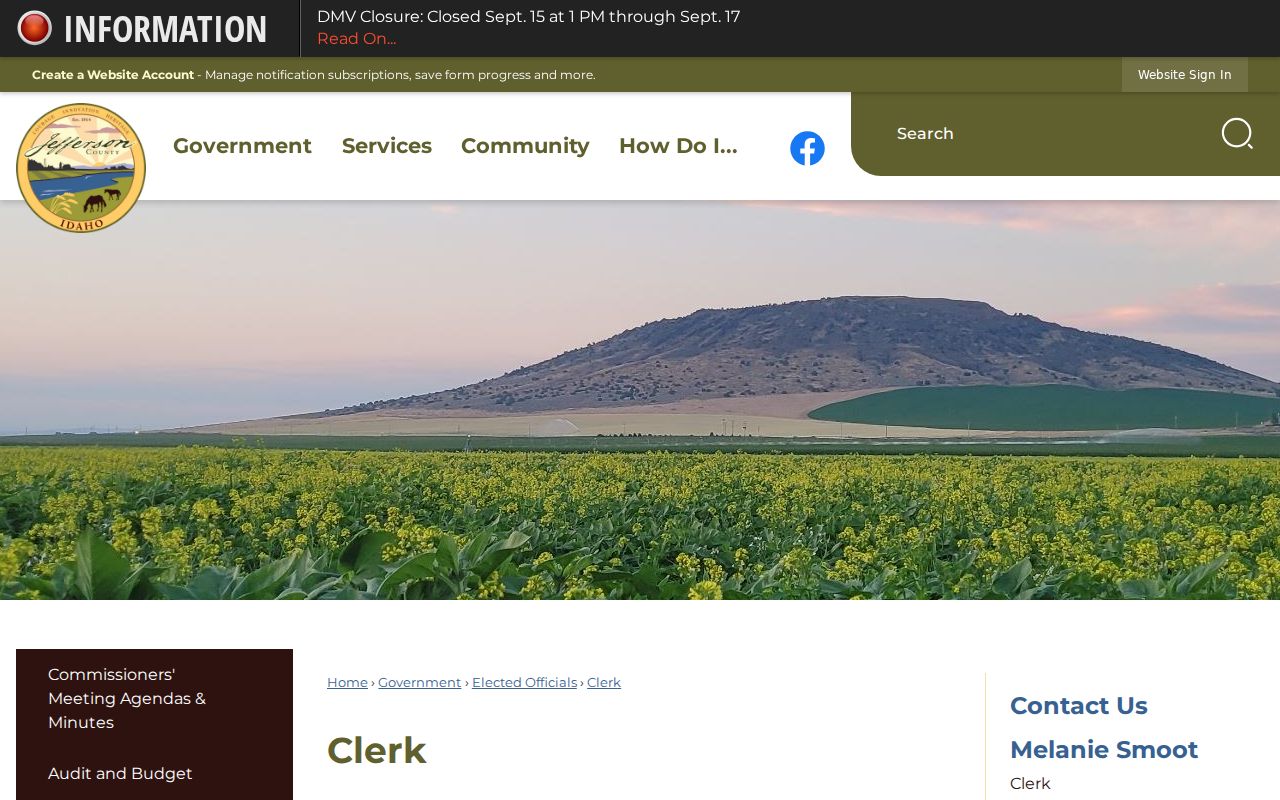
The page is an office locator, not a deed result. A useful inquiry still supplies names, parcel details, dates, and document types so staff can locate the actual record.
Requesting a Jefferson County Deed Copy
Contact the Clerk/Recorder at 210 Courthouse Way, Suite 100, Rigby, 208-745-7756, Monday through Friday from 9:00 a.m. to 5:00 p.m. Counter inspection, phone, mail or email arrangements, and the county public-record request form are the documented routes.
Include names, PIN, legal description, date span, document type, format, and whether inspection or copies are wanted. State if certification is required and confirm charges before ordering.
Recorded is not guaranteed. Jefferson County deed records show accepted instruments, not a title opinion or assurance that no unrecorded interest exists.
File each copy with its details. Keep the instrument number, recording date, legal description, and copy status together, so each deed record can be checked against the same parcel.